8þ Kabutoshimen
13Oct/110

New DVD’s from the Sweden Tai Kai 2011

Sveneric Bogsäter from Holland together with Rob Renner, Duncan Stewart and Steve Olsen from Japan was invited to teach at this Swedish Tai Kai organized by Mats Hjelm and Svenska Bujinkanförbundet. There was two DVD's and two download videos released from this seminar. This Video is one part of this set.

At the Taikai all instructors had three classes each, one class with the whole big group, one class with all Shidoshi (5'th dan and above), and one class with Mudansha & Yudansha (beginners up to fifth dan).

The instructions is all in ENGLISH. The DVD is Region Free and NTSC (US/Japan format, works on modern DVD players)

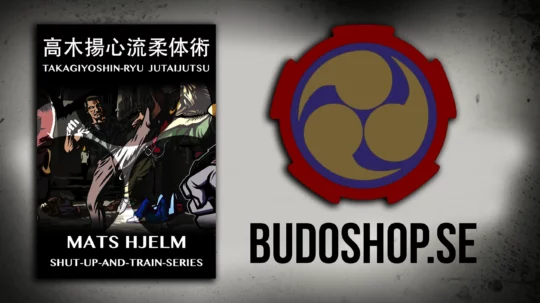
Available for 239.00 SEK at BUDOSHOP.SE

On this DVD - Sveneric Bogsäter & Rob Renner

This two hour DVD is packed with good demonstrations and instructions from Sveneric Bogsäter and Rob Renner. Sveneric had recently been in Japan, and Rob Renner has lived in Japan for many years, so what they taught was very much the feeling from Japan trainings with Hatsumi Soke and the Japanese Shihan.

Sveneric taught Kihon-happo variations against one or two opponents to the whole group. At the Shidoshi-class he taught Taijutsu and Hanbojutsu. At the Mudansha & Yudansha class he taught Taijutsu

Rob taught how to understand the distance and footwork with unarmed and with a Hanbo to the whole group. At the Shidoshi class he taught how to do the Kihon-happo techniques against someone who is resisting, directions, balance breaking and distance. Against one and several opponents. Rob's Mudansha and Yudansha class is available on download file only (click here!).

Duncan Stewart & Steve Olsen

Available for 239.00 SEK at BUDOSHOP.SE

On this DVD - Duncan Stewart & Steve Olsen

This two hour DVD is packed with good demonstrations and instructions from Duncan Stewart and Steve Olsen. Both Duncan and Steve has lived in Japan for many years, so what they taught was very much the feeling from Japan trainings with Hatsumi Soke and the Japanese Shihan.

Steve taught Taijutsu to the Shidoshi class and to the class with the whole big group. The Mudansha and Yudansha class is available only as download video (click here!).

Duncan taught drills how to learn the correct distance to the opponent, and Taijutsu techniques with or without small concealed weapons. To the whole big group he taught and demonstrated Taijutsu with devastating efficiency. Unfortunately there was no footage of his Mudansha and Yudansha class.

On This video – Steve Olsen

20 minutes, 243 Mb for $6.99
Only available as download

This video is 20 minute where Steve Olsen taught the Mudansha and Yudansha class (ranks below 5′th dan). He taught a little sword cutting technique but mostly Taijutsu.

On This video – Rob Renner

32 minutes, 388 Mb for $6.99
Only available as download

This video is 32 minute where Rob Renner taught the Mudansha and Yudansha class (ranks below 5′th dan). He taught footwork, distance, taijutsu and unarmed training drills that will make you understand the basics better.

25Sep/110

Modern warrior coming to Stockholm in October

Dean with the Bufuikkan menkyo

There are many people in the Bujinkan who claim to teach reality based techniques without any real experience. There is however a few people that can do this, and do it very good. And one of the best one I know is my close and good friend Dean Rostohar Shihan from Croatia. With his experience from the civil war in former Yugoslavia, and as a former police officer he certainly knows what he is talking about.

Dean goes to Japan to train with Hatsumi Soke and the Shihan several times per year. He always train three trainings per day, to make out most of his time in Japan. Hatsumi Soke always put him up to teach about his experiences. When he was there earlier this month even more so, Soke used him as Uke often to teach the real feeling. Soke also awarded him with the Bufu-ikkan menkyo which he only give to his top students.

When Dean doesn't go to Japan he practice in his own Dojo with over 100 students. He also attend many courses and seminars and further his studies in many areas with instructors outside the Bujinkan. He also practice shooting and military tactics with SPECWOG, and teach many seminars and courses.

In October 29-30'th I'm organizing a seminar with him in Stockholm. I can't emphasize enough how important a seminar like this is for everyone training in the Bujinkan system. Especially if you want to learn self defense and tactics how to defend yourself against a knife or pistol. Running backwards on a flat floor in the dojo all the time until the opponent overextend himself and fall down is fine, but how reality based is the training, really? Your instructor may say this is reality, and then do something pretty stupid and cover it up with a henka and flow so that you don't see how stupid the first response really was. OK, sorry! The word "stupid" might be a strong word, I know there is good teachers out there, but far from all. Being "stupid" is also a learning process that we all need to go through, but staying on the stupid level is just stupid ;-) .

I know there is many seminars all the time, and find the time and money to all is difficult. All I ask of you is to ask yourself what do you want from the training? If you think it is fun as it is in your dojo and you don't care much about reality then fine, good luck! If you on the other hand think that being able to defend yourself is important, then you should really try to attend this seminar (or any other Seminar with Dean)! I promise it will be very eye opening, and you will see your training with different eyes.

Both knife and pistol is very scary weapons, defending against them is very difficult. But it is possible if you also know how to use them as weapons. If you don't know how to use the weapons properly how can you say that you know how to defend yourself against them.

Dean Rostohar together with Noguchi Shihan, Hatsumi Soke and Kan Shihan.

This is the feeling Hatsumi Soke teach in Honbu dojo all the time. All instructors take what they want and do what ever they feel like for various reasons. By Hatsumi Soke using Dean in Honbu dojo so much, and constantly ask him to teach and explain in front of him, as well as being his Uke must mean that Hatsumi Soke appreciate what Dean is doing. I think also that Hatsumi Soke is learning from Dean as he watches.

So with this I really recommend you to come to this seminar! The web site is in Swedish, but there is translation buttons on top of the web site. If you have problem with the language, you can always contact me, I know the translator is not always 100% correct.

Remember to sign up, because the places is very limited!


23Mar/110

Istanbul seminar 2011

Haburamu dojo

I think this was my 7'th or 8'th time I've been invited by Ercan and the Bujinkan Haburamu Dojo in Istanbul. I feel honored to be invited back so many times, I must be doing something right. The organizer hadn't asked for any special theme so I joked and asked if they wanted chaotic training. And they said yes. Well if you know me I like to have a special theme to go by so I thought I would do the Gyaku-gi from Chi-ryaku no maki, but I would do them all both omote and ura.

Ura oni-kudaki

裏鬼砕 Ura oni-kudaki

逆技 GYAKU GI

  1. 竹折 Take-ori
  2. 表逆 Omote-gyaku
  3. 裏逆 Ura-gyaku
  4. 本逆 Hon-gyaku
  5. 表鬼砕 Omote oni-kudaki
  6. 裏鬼砕 Ura oni-kudaki
  7. 武者捕 Musha-dori
  8. 武双捕 Musō-dori
  9. 大逆 Ō-gyaku

It is said that when you take the opponent on his back you will let him live, you give him the gift of life. And if you take him down on his face you will take his life. When a samurai died on the battle field and was found dead lying with his face down they would say that he died with honor. If they found him dead on his back they would say he died without honor. So if you take the opponent on his back you should let him live and not die in shame.

At the seminar I showed all the above techniques as they should be done (my way!). I did henka, I did them omote and also ura. For example, most of you know that with omote-gyaku and musha-dori you take him backwards. But I also showed how to take him forwards with these techniques. This was the theme I had in mind when starting the seminar, doing an ura technique but taking him omote and the other way.

Henka

I started with the take-ori technique and did many variations, I got lost in time and when it was lunch I realized I had spent half the day on one technique and there was eight more techniques. After lunch I asked what they wanted to do, and someone had asked about musha-dori. So we spent most of the afternoon doing musha-dori, and ended with a simple sword technique.

Istanbul SwordNext day I kept doing the other seven techniques, and later finished with some more simple sword techniques and also hanbo-jutsu. I always enjoyed going to Istanbul for seminars because the students at the Haburamu dojo are so eager and willing to train.

Oh I got a new nick name, "the Bujinkan engineer" from Ercan and his students :-D . Because they said I show so many details in each movement. Well, that is how I look at my own training. I believe this is very important, to look at everything and study it in detail. I'm not satisfied looking at something from only the outside, I want o see how it looks from the inside, under, above, I want to feel the weight, texture, smell, taste, how it sounds and everything else I can think of. Just doing a technique without thinking about it and hope that I someday will understand is just not me.

Of course I can just show 1000 henka on a seminar and let people have fun and maybe not learning anything except moving around, I can do this to, but not too much. Trying to teach like Soke is impossible for me, I'm not technically ready yet. And I'm not doing anyone favors by trying to teach like Soke. But I'm geting there, I like to believe and hope that. I constantly jump between the shu-ha-ri levels; to keep moving, polishing my basics, and also moving freely and let the techniques come naturally. The last part is good for beginners to know about, but they must understand that this can not come easy until the basics have been perfected.

Sultan Ahmed Mosque

Besides from the training I had a good time. On Friday Ercan took me to the Basilica Cistern, this is the largest of several hundred ancient cisterns that lie beneath the city of Istanbul (formerly Constantinople). After this we went to the Topkapı Palace which was the official and primary residence in the city of the Ottoman Sultans for approximately 400 years (1465-1856) of their 624-year reign. We also passed the Sultan Ahmed Mosque. Ercan told me this story; when the Sultan ordered the Mosque to be built he asked for gold minarets, in Turkish language gold is altın. But the architect heard altı which means six. Hence the six minarets of the Blue Mosque. After the sightseeing we had dinner and then the boat back home to prepare for the extra training later this evening.

The food in Turkey is excellent, I especially like Adana Kebab and Şalgam. I was a little disappointed about the pubs, the one that was supposed to be the best had recently closed, "The English Pub" did not even have English beer (not even Guine55 or Ki11kenny), the brewpub turned out to be a loud disco with only one bad pilsener on tap and one slightly better on bottle. But the company of old and new friends was very nice and that is much more important.

After all I had a good time, and look forward coming back soon.

I'd like to say thank you to Ercan for organizing everything! And also to all the people attending the seminar which made all this possible.

See more pictures from this trip, click here.

Ercan filmed the seminar, and he also got film from my camera. Contact him if you are interested in a DVD of this seminar.

Sample video clip

Buy the full 75 minute video


75 minutes, 540 Mb for $14.99  

This video is not available as DVD!


2Mar/110

Riga seminar in February 2011

The past weekend I was invited by Juris from Bujinkan Kurokawa Dojo in Riga to teach a seminar on Sanshin no kata and Juttejutsu.

On Saturday I showed and explained the way I feel is the base for Sanshin no kata. First we did the traditional warm-up routine; doing the first technique five times on the right side, and then five times on the left side, and finally ten times alternately on right and left side. Then the same with all the other four techniques. Sanshin no kata consists of five simple techniques...

Sanshin no kata

三心の型 SANSHIN NO KATA

地 CHI (earth)
水 SUI (water)
火 KA (fire)
風 FŪ (wind)
空 KŪ (void)

In the early 1980's there was a "guy" that had only been training a couple of years and interpreted these techniques with Buddhism and created his own philosophy around these techniques. He wrote many books on the subject, and almost everyone copied his idea. It was a very nice idea, but it was not the Sanshin no kata that Hatsumi Soke taught as many people believed at the time (and unfortunately still believes). Do not think of the elements too much. Just simply look at them as a way of counting, nothing else.

Some people talk about three different ways of doing these techniques and they also have a name (shoshin, gogyo, goshin). I have never been taught this by Hatsumi Soke or any one else of the Japanese Shihan, and I have never seen the source for this. So I'm not teaching this, but I think this also is a good idea. I think it is important to always look at things from three perspectives. For example left, right and middle. The way I taught on the seminar was the following.

The principle of capturing, strike and quickly capture again

Solo training, try to get the form correct and understand all movements, angles, timing, distance, technique, kamae and everything else. I heard that even the Japanese Shihan who have been training for 30-40 years still do this every day. So there is no reason for you to think that you have already learned it. I to still discover many things when doing the forms.

With a partner you will understand the the solo training forms better. The forms you do in solo training will never bee exactly the same when done with a partner, you need to adjust according the way your partner attacks. We did the base (as I see it!) with five different blocks and five different strikes, then moved on to applications and more direct response from natural posture.

Using weapons will increase the understanding even more. If you use a weapon try to keep to the ideas we learn from the forms. But small adjustments are done according the characteristics of the weapons used.

This 45 minute video from the seminar is available for instant download at BUDOSHOP.SE

十手術 JUTTEJUTSU

the JutteThe jutte or jitte (十手), literally meaning "ten-hand" (i.e., the weapon with the power of ten hands), is a specialized weapon. In Edo period Japan the jutte was a substitute for a badge and represented someone on official business and was carried by all levels of police officers including high ranking samurai police officials and low-rank samurai law enforcement officers (called okappiki or doshin). Other high ranking samurai officials carried a jutte as a badge of office, "aratame" or official inspectors including hotel, rice and grain inspectors carried a jutte.

On Sunday we did the six techniques from the old Hanbo, Tessen and Jutte book published by Hatsumi Soke in 1984 ca. It has six basic techniques, we did them all. In 2003 the Bujinkan theme was Kunai and Hatsumi Soke taught five of these techniques using a Kunai. The weapons are different so adjustments need to be made according the characteristics of these weapons.

落花 Rakka technique

We studied the following techniques with Jutte in mind (not Kunai), first the basic form and then variations and applications.

桐之一葉 KIRI NO HITOHA – falling paulowina leaf (arrival of autumn)
落花 RAKKA – falling blossoms
水鳥 MIZU-DORI – water bird / 五輪碎 GORIN KUDAKI – five rings crush
雷閃 RAI-SEN – flash of lightning
竜下 TATSUGE – inferior dragon
廻捕 MAWARIDORI – revolve and capture

The training both days seemed to be successful and everyone seemed happy about it. I sure had a good time both in the dojo and outside before, between and after the trainings. The first time I was in Latvia in 2002? I asked about traditional masks but I didn't know so much about them that they understood what I meant. So after the training Juris surprised me with a mask I asked about nearly ten years ago.

The arrival of masked visitors

This practise is variously referred to as budēļi, čigāni "gypsies, going gypsying", kaladnieki, ķekatas, maski "masks, going masking", nabagi "the poor ones", etc. Although this practise could occur at any time of the winter (between Mārtiņi and Meteņi ), it was particularly common on Christmas eve. It is strongly reminiscent of the tradition of mummers and mummering in Great Britain and Newfoundland.

Latvian "mummers" might dress up as animals (bears, horses, cranes) or as Death. They would go from house to house and were warmly greeted, as they were assumed to drive away evil spirits. They would arrive in groups in front of the house, and sing songs and dance. Then they would be invited in and fed with bacon buns (pīrāgi), butter, sausages, and given ale to drink. They made a special effort to disguise their voices and mannerisms, so that no one would be able to guess who each one was, but if a mummer was correctly identified, he or she would have to "unveil", i.e. remove the cloth which was covering their face.

It is still common for children to be required to recite an appropriate verse before receipt of their presents (there are many).

Vai, lielie ziemas svētki,
Puiši trekni, zirgi vāji;
Puišiem alus, brandavīns
Zirgiem tukšas redelītes.

Oh my, Christmas time
The lads are fat, the horses lean;
The lads get beer and whiskey
But the hay racks are empty.

I'm happy about the whole seminar, and especially happy that people also came from the neighboring countries Estonia and Lithuania. I was asked to come back after summer, maybe in August. I'm already looking forward to it.

Thank you Juris and everyone who attended and made the seminar possible.

Happy training!

Click here for more pictures from the seminar.

10Apr/103

Special offer! Tachi Kumiuchi w Duncan Stewart – Three set DVD’s

TACHI KUMIUCHI - SPECIAL LIMITED EDITION for only 549.00 SEK
3-Set DVD + Bonus CD only valid until the end of April!

We had Duncan Stewart here in Stockholm for a seminar in the beginning of April this year. We filmed all the trainings and will release them on three separate DVDs, each one is 2 hours long, total of 6 hours of very good stuff. They will be available for order separately at BUDOSHOP.SE from May 1'st. But we are offering a special offer for a limited edition only available for a very short time, please read below!

The price is 549.00 SEK (it is around 56.00 EUR or 75.00 USD), this will save you 168.00 SEK. We will even throw in 30 min extra material that we couldn't squeeze in. This bonus CD will not be available again, only the DVD's will be sold separately for 239.00 SEK each from May 1'st.

You can order this now, but it will be shipped in the end of April, if you order more from the shop we might wait and ship everything at once. All our videos is NTSC and region free! We have a flat shipping rate to the whole world for only 49.00 SEK (free shipping with in Sweden). For those of you who pre-ordered and already paid this at the seminar will get the limited edition set.

Click here to buy it from BUDOSHOP.SE (Note we only accept SEK via PayPal!)

Here is some information about each DVD...

the first DVD theme is Kihon Happo. This DVD is from the extra training on Friday. Duncan taught Kihon Happo and basics, but also more advanced, unarmed or weapons, and Tachi Kumiuchi.

the second and third DVDs theme is Tachi Kumiuchi and the concept of Rokkon Shoujou, the theme of this year. Taijutsu, unarmed fighting against one or multiple attackers, with or without weapons, mainly the Tachi sword.

the bonus cd is from the end of Sunday training. We couldn't omit anything from what we filmed in the editing process, and still wanted to give you everything we captured. It will be in the format of H264 movie you can play on your computer or phone.

If you don't know who Duncan is I advise you to ask anyone who has been to Japan the past several years. He is often used as uke by Hatsumi Soke and the Shihan. There is videos on YouTube you can watch, also read his own blog which is very good and insightful.